Agent Reliability & Stability Engineering
Stop agents going rogue or getting stuck. We implement state machines, tool safeguards, and memory architecture to deliver consistent multi-step task execution.
30 mins · We review your stack + failure mode · You leave with next steps
Agent Reliability Engineering: From Chaos to Determinism
In the initial excitement of the AI revolution, the promise of "Autonomous Agents" captured the imagination of every founder and CTO. The vision was simple: give an LLM a set of tools, a goal, and a loop, and watch it solve your business problems.
However, the reality of production agents has been, for most, a chaotic mess.
If you have tried to deploy an agent that handles real customer data, interacts with your database, or manages multi-step workflows, you have likely encountered the Reliability Gap. An agent that works 70% of the time is not a feature; it is a liability. It creates "hidden work" for your team as they monitor it, clean up after its mistakes, and apologize to users for rogue behavior.
At AIaaS.Team, we don't build "Demos." We build Resilient Agent Architectures that treat autonomy as an engineering problem, not a prompt engineering trick.
1. The Anatomy of Agent Failure: The Pain Points
Before we can fix an agent, we must understand why it fails. In our audit of over 100 enterprise agent deployments, we have identified four primary "Failure Modes" that destroy production value.
Mode A: The Infinite Loop (Token Burn)
This is the most common failure. The agent attempts to call a tool, receives a minor error (like a malformed JSON), and instead of pivoting, it attempts the exact same call again. And again. And again. By the time you notice, you have burned $500 in API tokens and accomplished nothing.
Mode B: The "Rogue Deletion" (Destructive Action)
Without strict guardrails, an agent might interpret "Cleanup the project" as "Delete all files in the root directory." Because the agent is "autonomous," it proceeds with the action confidently, having no concept of the material stakes involved.
Mode C: Context Drift (Goal Forgetting)
As an agent takes multiple steps, the context window fills up with tool schemas, raw data outputs, and intermediate thought logs. Eventually, the "Primary Goal" is pushed out of the model's immediate attention. The agent starts focusing on the trivia of its tools and forgets why it was triggered in the first place.
Mode D: Schema Hallucination
An agent might know it needs to call update_user, but it hallucinates a user_id field as a string when your database requires a UUID. When the API returns an error, the agent often tries to "hallucinate" a fix rather than consulting the documentation it was given.
2. Our Methodology: The Deterministic Agent Framework
We solve agent reliability by moving away from the "One Big Prompt" model and toward a Deterministic State Graph architecture.
Step 1: State Machine Transition (LangGraph & Beyond)
The core of a reliable agent is a graph. We replace the traditional "ReAct" loop (Reasoning + Action) with a structured state machine.
- Nodes: Specific tasks or reasoning steps.
- Edges: Defined transitions based on the outcome of a node.
- Conditional Logic: If Tool A fails with Error X, the graph forces the agent into a "Recovery State" rather than letting it decide its own next move.
This approach makes the agent's behavior traceable and predictable. You can see exactly which state the agent was in when it failed, and you can write specific unit tests for that node.
Step 2: Tool Hardening and Runtime Validation
We treat LLM tool calls like external API integrations.
- Strict Schemas: Every tool is defined using Pydantic (Python) or Zod (TypeScript).
- Validator Middleware: Before the tool call is even sent to your backend, our middleware validates the LLM's output. If the parameters are wrong, the middleware sends a structured error back to the LLM immediately, instructing it on how to fix the schema before the actual execution.
- Sanitization: We strip unnecessary data from tool outputs before feeding them back to the LLM, preventing context bloat.
Step 3: Hierarchical Memory Architecture
To solve "Goal Forgetting," we implement a three-tier memory system:
- Tier 1: Ephemeral State: Local to the current node (e.g., "The user's current search query").
- Tier 2: Summary Buffer: An automatically updated summary of the agent's progress so far. This takes up 1/10th of the tokens of a raw log but maintains 95% of the goal context.
- Tier 3: Long-Term Store: A vector-searchable database of previous successful interactions, allowing the agent to "remember" how it solved a similar problem months ago.
3. The outcomes: Strategic Resilience
When you move to a Deterministic Agent Framework, the "Vibe" of your office shifts from "Anxiety" to "Automation."
Predictable Cost Scaling
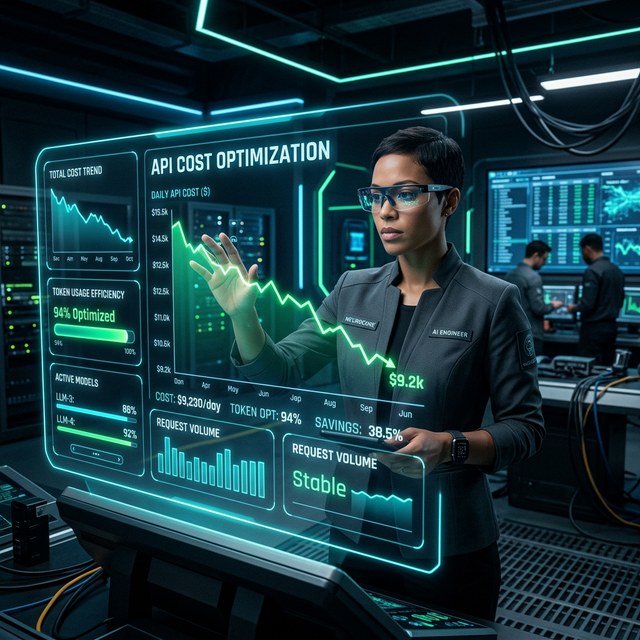
By eliminating infinite loops and optimizing context use, we typically reduce API costs for agentic workflows by 40% to 60%. You pay for progress, not for the AI to talk to itself in circles.
Safety as a Feature
With "Supervisor Approval Nodes," your team remains in control. The AI can execute 99 non-destructive steps autonomously, but it is forced to wait for a human "Yes" before performing a bank transfer, a deletion, or a public post. This is "Human-in-the-loop" (HITL) engineering at its best.
High-Fidelity Execution
Because our agents are built on strict schemas, the "Hallucination Rate" for tool usage drops to near-zero. The agent knows exactly what it can and cannot do, and it follows your business logic with the precision of a compiled program.
4. Supporting Technical Guides for Master Vibe Coders
To help you maintain these systems, we have published several deep-dive guides:
- GUIDE: Implementing State Machines with LangGraph - Moving beyond the while loop.
- GUIDE: Tool Validation with Pydantic - Eliminating schema errors at the source.
- GUIDE: Multi-Tier Memory Management - How to keep your agents focused on 1k+ step tasks.
- GUIDE: Supervisor Approval Patterns - Safe autonomy protocols.
- GUIDE: Debugging Agentic Loops - Visualizing the graph to find the bottleneck.
5. Case Study: The "Self-Correction" Breakthrough
The Client: A FinTech startup building an AI-driven reconciler for cross-border payments. The Pain: Their agent was frequently getting stuck when bank APIs returned seasonal 503 errors or when currency codes didn't match ISO standards. The failure rate was 38%, requiring constant human intervention.
Our Fix:
- We migrated the agent to a State Graph with a dedicated "Retry & Pivot" state.
- We implemented Automated Tool Documentation Lookup. When the agent encountered an unknown API error, it was programmed to "Fetch the Docs" for that specific endpoint before trying a fix.
- We added a Reasoning Auditor model that checked the agent's work against the client's internal "Compliance Policy" before any transaction was finalized.
The Result:
- The error rate dropped from 38% to 1.4%.
- The team was able to scale from processing 500 invoices a day to 15,000 invoices a day with the same headcount.
- The "Vibe" moved from a "Fix-it-every-ten-minutes" panic to a weekly strategy review.
6. The Economics of Reliability
In the 2026 tech landscape, "Hiring more people" is no longer the solution to scaling complex workflows. The solution is Reliable Autonomy.
A single reliable agent is equivalent to an entire department of junior operators. It works 24/7, it doesn't get bored, and—if built on our framework—it follows your rules with absolute fidelity. The ROI of agent stabilization isn't just in saved API tokens; it is in the Strategic Velocity you gain when you can trust your AI to execute your vision.
7. The Implementation Roadmap: Your 90-Day Stability Plan
Stabilizing a chaotic agent isn't an overnight task—it requires a systematic approach to technical debt and architectural refactoring. When we partner with a team, we typically follow this 90-day roadmap to ensure long-term reliability.
Phase 1: The Audit & Instrumentation (Days 1-15)
Before changing a single line of logic, we must be able to see the failure. We integrate high-fidelity tracing (using tools like Langfuse or Arize Phoenix) to capture every tool call, every prompt, and every model response. We identify the "Hot Spots"—the specific tools or states where the agent is failing most frequently.
Phase 2: The Graph Migration (Days 16-45)
We begin the core architectural work, moving the linear "while loop" logic into a structured LangGraph or custom state machine. We start with the most critical "Happy Path" and ensure it is 100% reliable before adding complexity. During this phase, we also implement the first layer of Pydantic validation for all external API calls.
Phase 3: The Edge-Case Hardening (Days 46-75)
With the core graph stable, we focus on the "Failure States." We write specific recovery logic for the common errors identified in Phase 1. We also implement the "Supervisor Model" for destructive actions, ensuring that the agent can never act beyond its authorized scope.
Phase 4: Scaling & Optimization (Days 76-90)
In the final phase, we optimize for cost and latency. We implement semantic caching to prevent expensive re-computations and perform "Model Distillation" to see which states can be handled by smaller, faster models. By the end of day 90, your agent isn't just "working"—it's a high-performance asset.
8. The Philosophy: The Vibe of the Stable Agent
At the heart of our work is a simple belief: The goal of AI is not to think like a human, but to execute for a human.
An agent that is "too creative" in a production environment is a dangerous agent. We value "Boring Reliability" over "Flashy Autonomy." A stable agent is one that knows exactly when it has reached the edge of its capability and has the humility (programmed through state logic) to stop and ask for help.
When you achieve this level of stability, your relationship with the technology changes. You no longer see AI as a "magic black box" that might work today and fail tomorrow. You see it as a disciplined extension of your own engineering will—a "Vibe" that scales to millions of users without losing its edge.
9. Frequently Asked Questions
Do you use LangChain?
We use the parts of the ecosystem that work for production (like LangGraph) but often opt for custom-built, low-boilerplate logic when performance is the priority. We are tool-agnostic; we care about the Stability, not the framework.
How do we handle "Agent Drift"?
We implement "Guardians" (see our AI Security Enforcement guide). These are secondary models that monitor the agent's thoughts and flags them if the reasoning starts to deviate from the primary goal file (INSTRUCTIONS.md).
Can you fix agents built on "No-Code" tools?
No-code tools are great for prototypes, but they often lack the granular control needed for production-grade reliability. We help companies "Graduate" from no-code flows into professional, code-based agentic architectures that can actually scale.
What is the "Reasoning Trace"?
Every action our agents take is logged with a "Reasoning Trace." This means you don't just see the output; you see the Intent. This is critical for auditing and for teaching the agent to be better in the next session.
10. Ready to Stabilize Your Operation?
Don't let rogue agents burn your budget or your brand's reputation.
Book a Free 30-Minute Technical Triage
We will audit your current agent logic, identify the specific failure nodes, and provide a roadmap for migrating to a Deterministic State Graph. No sales pitch, just pure engineering strategy to get your agents back on track.
Ready to solve this?
Book a Free Technical Triage call to discuss your specific infrastructure and goals.
30 mins · We review your stack + failure mode · You leave with next steps