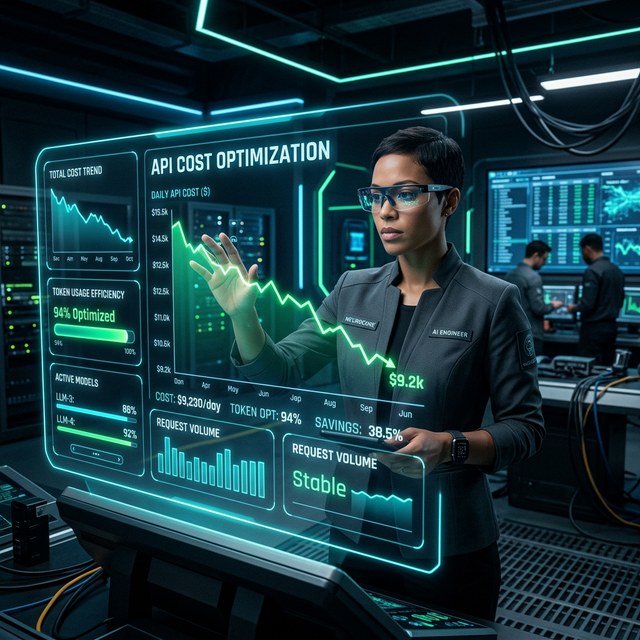
LLM Cost Optimization & Inferencing Efficiency
Stop burning VC money on OpenAI bills. We implement caching, sensible routing, and optimize prompt pipelines to slash inference costs.
30 mins · We review your stack + failure mode · You leave with next steps
The Hidden Tax: Solving the Crisis of Scaling LLM Costs
The trajectory of every successful AI product is often predictable: The MVP launches to rave reviews, the user base scales exponentially, and 60 days later, the founders are staring at an OpenAI or Anthropic bill that is devouring their entire margin.
This is the Inference Crisis.
In the race to build features, most teams default to "The smartest model for everything." While this ensures quality during the prototype phase, it is a ruinous strategy at scale. Using a Frontier model (like Claude 3.5 Sonnet or GPT-4o) to classify a support ticket or summarize a 200-word email is like using a rocket ship to deliver a pizza. It works, but the economics are insane.
At AIaaS.Team, we specialize in Strategic Cost Engineering. We don't just "buy tokens"; we architect systems that treat token consumption as a precious resource.
1. The Anatomy of Token Waste: Where Your Money is Going
In our audits of high-scale AI applications, we consistently find the same three areas of massive financial leakage.
leakage A: The Redundancy Loop
Users are predictable. In a typical RAG (Retrieval-Augmented Generation) system or customer support bot, up to 30% of queries are semantically identical. If 1,000 people ask "How do I reset my password?", and you send 1,000 separate calls to Claude 3.5, you are paying for the same answer 1,000 times. This is institutionalized waste.
Leakage B: The Reasoning Overkill
Many engineering teams have one system prompt that they send to the top-tier model for every single interaction. But "Extract the user's name" does not require a model capable of solving quantum physics equations. By failing to "triage" the complexity of a task, teams pay a 10x to 50x premium for reasoning power they don't actually use.
Leakage C: The "Prompt Bloat"
Prompts often grow as teams add more edge-case instructions. A 2,000-token system prompt might solve a specific bug, but if that prompt is sent with every 100-token user query, you are paying for 2,100 tokens to get 100 tokens of value. Over millions of requests, this "bloat" translates into tens of thousands of dollars in wasted spend.
2. Our Methodology: The Efficiency Stack
We solve the Inference Crisis by implementing a multi-layered Optimization Middleware between your application and the LLM providers.
Layer 1: Semantic Caching (The 0-Cost Layer)
We integrate a vector-based caching layer (using Redis or Upstash).
- When a query comes in, we generate a mathematical representation (embedding) of the intent.
- We check the cache for a "Near-Match."
- If we find one with high confidence, we serve the cached answer immediately.
- Result: 0 wait time for the user, 0 cost for you.
Layer 2: Dynamic Intent Routing
We deploy a lightweight "Router" (often a 1B-parameter model or a set of regex rules) that classifies the difficulty of the incoming request.
- Level 1 (Simple): Formatting, extraction, or basic classification -> Routed to GPT-4o-mini or a locally hosted Llama-3-8B.
- Level 2 (Moderate): Information synthesized from RAG -> Routed to a mid-tier model.
- Level 3 (Complex): Strategic reasoning or novel problem-solving -> Routed to the Frontier Model.
- Result: A blended cost profile that is often 70% lower than using the Frontier model for 100% of traffic.
Layer 3: Context Minification & Prompt Engineering
We systematically optimize your prompt architecture.
- Instruction Compressing: Using LLMs to rewrite your system prompts into high-density language that uses fewer tokens but maintains instructions.
- Context Pruning: Implementing smarter RAG retrieval that only pulls the top 3 most relevant chunks instead of "everything that mentions the word."
- Few-shot Distillation: Moving from long examples in the prompt to a small, fine-tuned model that "just gets it" without needing the examples.
3. The outcomes: Margin-Safe AI
By re-architecting for efficiency, we turn your AI feature from a "Cost Center" into a "Profit Engine."
Protected Margins
When your cost-per-user drops by 60%, your ability to scale changes. You can offer a "Free Tier" that doesn't bankrupt you, or you can reinvest that saved margin into faster growth and marketing.
Sustainable Unit Economics
We help you calculate your "Marginal Token Cost." This metric allows your finance team to predict exactly how much an extra 10,000 users will cost, removing the "Bill Shock" that keeps founders awake at night.
Performance Gains
A side effect of optimization is speed. Small models and cache hits return results in milliseconds, not seconds. Your users get a "snappier" experience while you pay a fraction of the price.
4. Supporting Technical Guides for Efficiency Master
- GUIDE: Setting Up Upstash for Semantic Caching - A technical walkthrough for near-instant response times.
- GUIDE: Architecting a Model Router with Vercel AI SDK - How to build the triage layer.
- GUIDE: Prompt Compression Techniques for GPT-4o - Saving tokens without losing soul.
- GUIDE: Fine-Tuning for Cost Reduction - When to move from prompts to weights.
- GUIDE: Token Monitoring and Alerting - Building a "Dashboard of Truth" for your AI spend.
5. Case Study: The 68% Cost Crush
The Client: A legal-tech startup processing thousands of court documents daily. The Pain: They were using GPT-4 to summarize documents and extract key dates. Their monthly API bill hit $22,000 while their revenue was only $30,000. They were on the verge of shutting down the feature because the margins were too thin.
Our Fix:
- Classification Triage: We discovered that 80% of "summaries" were actually just boilerplate extractions. We routed these to GPT-3.5-Turbo (and later GPT-4o-mini).
- Semantic Caching: Many documents shared the same local regulations. We cached the summaries of these regulations.
- Prompt Cleanup: We reduced their system prompt from 2,800 tokens to 450 tokens through rigorous instruction pruning.
The Result:
- Monthly bill dropped from $22,000 to $6,900.
- Output quality remained at 99% parity with the original setup.
- Processing time for the end-user was reduced by 40%.
- The startup became profitable within 30 days of the deployment.
6. Philosophy: The Economics of the Vibe
At AIaaS.Team, we believe that Efficiency is a Creative Constraint.
When you have infinite money, you write lazy prompts and use the biggest models. But when you architect for efficiency, you are forced to understand the "Intent" of your application more deeply. This leads to cleaner code, better data structures, and a product that is fundamentally more robust.
We don't just want to save you money; we want to give you the Economic Runway to build the future without being taxed out of existence by the model providers.
7. The Vibe of Efficiency: Building a Token-Aware Culture
Beyond the architecture, the most sustainable way to control costs is to build a Token-Aware Development Culture. When your engineering team treats tokens like bytes in the 1970s—as a precious, limited resource—your entire product becomes leaner and faster.
We help your team implement:
- Prompt Unit Testing: Every prompt must go through a "Token Audit" before being merged into the main branch.
- Cost-Aware CI/CD: We add checks to your deployment pipeline that flag significantly larger prompts or expensive model shifts.
- The 'Mini-First' Rule: A philosophy where every new feature must start on the smallest possible model (like GPT-4o-mini) and only move "Up-Coast" to more expensive models if a quality benchmark isn't met.
By institutionalizing these habits, you ensure that your cost reduction isn't a one-time "cleanup" project, but a permanent competitive advantage.
8. Comparing the Ecosystem: Where to Host Your Inference
Not all model providers are created equal when it comes to your bottom line. Part of our triage process involves helping you choose the right "Inference Home."
| Provider | Best For | Cost Profile |
|---|---|---|
| OpenAI / Anthropic | Rapid prototyping & extreme reasoning. | High (Pay-per-token) |
| AWS Bedrock / Azure | Enterprise security & reserved throughput. | Moderate to High |
| Together.ai / Groq | High-speed open-source inference (Llama/Mixtral). | Low (High Speed) |
| Self-Hosted (vLLM) | Extreme volume & private data. | Fixed (Compute based) |
We help you navigate this "Inference Map" to find the bridge between performance and price that fits your specific funding stage.
9. The Implementation Roadmap: Your 90-Day Cost-Reduction Plan
Phase 1: The Audit (Days 1-15)
We implement comprehensive logging and "Cost per Request" tracking. We identify the specific prompts and users that are driving 90% of your spend. We deliver a "Waste Audit" showing exactly where the leakage is happening.
Phase 2: The Infrastructure Layer (Days 16-45)
We deploy the Semantic Cache and the first version of the Model Router. We start by routing only the lowest-stakes tasks to smaller models to build baseline confidence in quality.
Phase 3: The Prompt Pruning (Days 46-75)
We refactor the most "expensive" prompts in your system. We implement dynamic context retrieval (RAG) to ensure the LLM only sees what it absolutely needs to see.
Phase 4: Long-Term Scaling (Days 76-90)
We explore fine-tuning or dedicated-GPU hosting for your highest-volume tasks. We finalize your "Cost Dashboard" so your team can monitor efficiency in real-time.
8. Frequently Asked Questions
Won't using smaller models make my product 'dumber'?
Not if the tasks are properly categorized. A smaller model is actually better at following simple formats (like JSON) than a larger, more "creative" model that might wander off-script. We call this "Purpose-Built Intelligence."
How much do you charge for the audit?
We offer a Free Technical Triage where we spend 30 minutes looking at your current architecture and estimate your potential savings. If we can't save you at least 3x our fee, we won't take the project.
Is my data safe if you add a caching layer?
Yes. We use private, encrypted instances for your vector cache. We ensure that user A can't see a cached response intended for user B through strict scoping and tenant isolation logic.
Can you help with open-source models?
Absolutely. We are big proponents of Llama-3, Mistral, and DeepSeek for cost optimization. We can help you deploy these to private VPCs or managed providers to drastically cut your reliance on proprietary APIs.
9. Ready to Stop the Token Burn?
Don't let your success be your downfall. Take control of your AI unit economics today.
Book a Free 30-Minute Technical Triage
We will review your last 30 days of API usage, identify your most expensive "Waste Nodes," and provide a roadmap for cutting your costs without losing your technical edge. No sales pitch, just pure fiscal and technical strategy.
Ready to solve this?
Book a Free Technical Triage call to discuss your specific infrastructure and goals.
30 mins · We review your stack + failure mode · You leave with next steps